The sitting president of the United States called FIFA’s president to get a soccer player unbanned, celebrated on Truth Social like he’d personally won the World Cup, and the United States still got bounced in the Round of 16 by Belgium. Four goals to one. That’s the whole story, really.
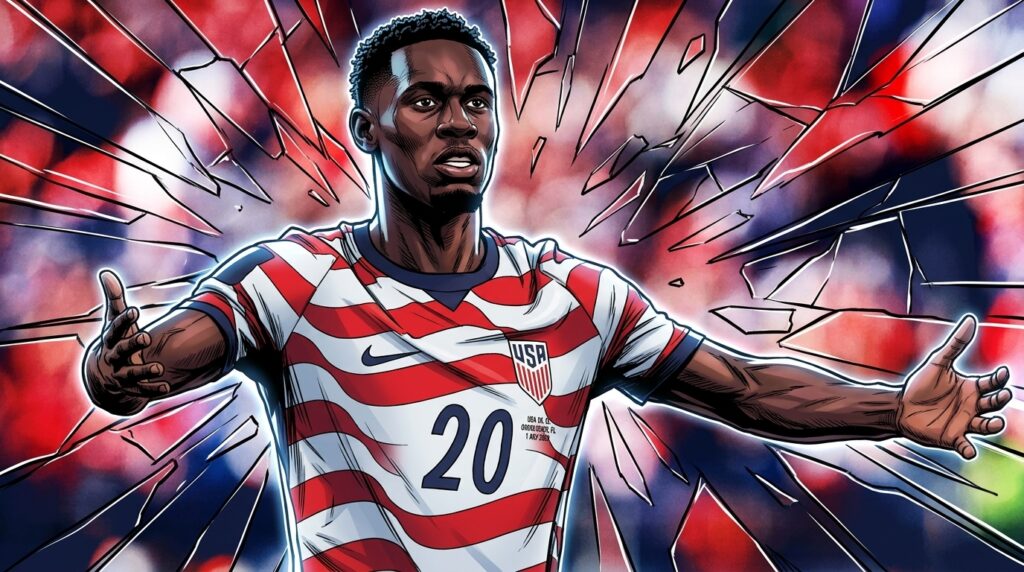
Here’s a little backstory if you missed it: Folarin Balogun caught a red card on July 1 after a VAR review ruled he’d stepped on a Bosnian player’s ankle. Balogun’s own take was that “a yellow card would have been fair,” which, honestly, is pretty measured for a guy staring down a one-game ban in a knockout tournament. The rules are the rules. He was out.
Then Donald Trump called Gianni Infantino. Trump confirmed it publicly: “I asked for a review because I didn’t think it was a foul. I didn’t know what the hell a red card was.” He added, generously, “I didn’t say, ‘You have to do this.'” FIFA then dusted off Article 27 — a mechanism so rarely used that the last known invocation was the Garrincha case in 1962, which was, per the historical record, also widely believed to involve political pressure — and suspended the suspension. Belgium’s appeal was denied. FIFA said they had “no standing.” The phone call that was supposed to change everything had worked.
Trump posted: “Thank you to FIFA for doing what was right, and reversing a great injustice! President DONALD J. TRUMP.” The all-caps signature is a nice touch on a post about a VAR call.
🚨 Donald Trump on Folarin Balogun red card case: “Thank you to Fifa for doing what was right and reversing a great injustice”. pic.twitter.com/u2iOBk8LL4
— Fabrizio Romano (@FabrizioRomano) July 5, 2026
UEFA called it “unprecedented, incomprehensible and unjustifiable” and said FIFA had “crossed a red line.” Rudi Garcia, Belgium’s coach, said he didn’t know the World Cup had moved April Fools’ Day to July 5th. Sepp Blatter — Sepp Blatter, the guy — went on record: “Red cards are not overturned by political phone calls.” Thomas Tuchel said it was “just strange,” asked on what grounds the reversal happened, then raised the reasonable follow-up of how far this goes now. Nobody has a satisfying answer.
Balogun started in Seattle on July 6. He didn’t score. He didn’t assist. He did win the foul that set up Christian Tillman’s deflected free kick in the 31st minute, which briefly made it 1-1 and allowed everyone to pretend this might be a game. It was not a game. Belgium had already gone up through De Ketelaere in the 9th minute, De Ketelaere again in the 33rd made it 2-1 before halftime, Vanaken added a third in the 57th, and Lukaku put one in at 90+3 to close out a 4-1 final. The xG was Belgium 2.15, USA 0.67. Balogun unbanned and the scoreline still said 4-1.
Pochettino kept it brief after: “We were not good enough today. We don’t need to find another excuse.”
That’s the right read, tactically. The excuse structure was all there — the political circus, the last-minute eligibility ruling, the genuine weirdness of what it looks like when the president plays general manager for a national soccer team on the international stage. US Soccer even filed a formal legal submission arguing that VAR had used slow-motion footage improperly per the rules. There was a whole procedural fight waged and won. And then the team went out and got outshot, outpassed, outclassed.
The intervention didn’t save them. It just made the loss stranger. Belgium 4, USA 1, courtesy of a legally unprecedented FIFA ruling, a Truth Social victory lap, and a team that couldn’t convert 0.67 expected goals on the biggest stage in the sport.
The article stays in the history books. The score stays in the history books too.